 electrown.com
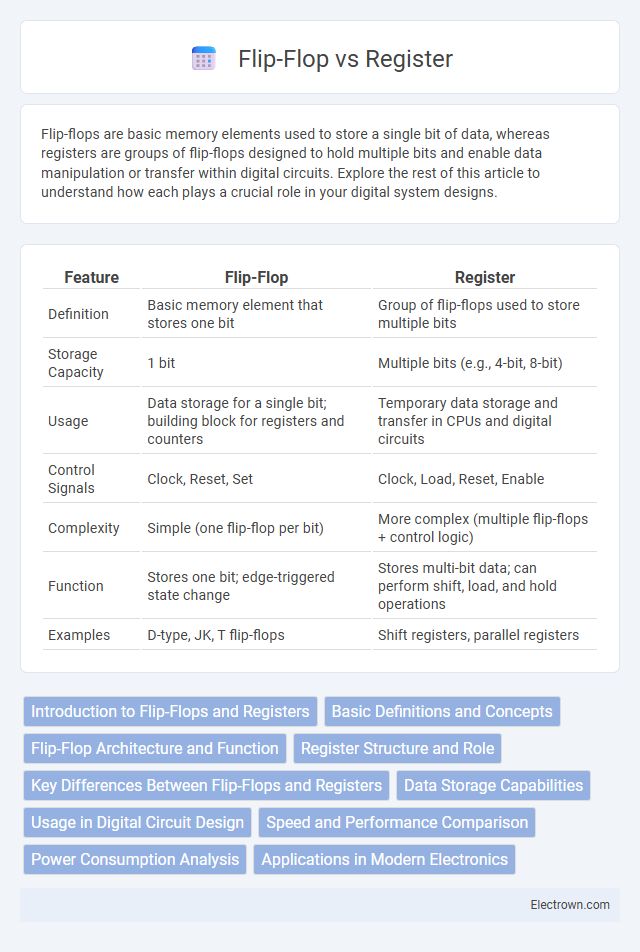
 Flip-flops are basic memory elements used to store a single bit of data, whereas registers are groups of flip-flops designed to hold multiple bits and enable data manipulation or transfer within digital circuits. Explore the rest of this article to understand how each plays a crucial role in your digital system designs.
Table of Comparison
| Feature | Flip-Flop | Register |
|---|---|---|
| Definition | Basic memory element that stores one bit | Group of flip-flops used to store multiple bits |
| Storage Capacity | 1 bit | Multiple bits (e.g., 4-bit, 8-bit) |
| Usage | Data storage for a single bit; building block for registers and counters | Temporary data storage and transfer in CPUs and digital circuits |
| Control Signals | Clock, Reset, Set | Clock, Load, Reset, Enable |
| Complexity | Simple (one flip-flop per bit) | More complex (multiple flip-flops + control logic) |
| Function | Stores one bit; edge-triggered state change | Stores multi-bit data; can perform shift, load, and hold operations |
| Examples | D-type, JK, T flip-flops | Shift registers, parallel registers |
Introduction to Flip-Flops and Registers
Flip-flops are fundamental digital circuits used to store a single bit of data, serving as the basic building blocks for memory elements in sequential logic. Registers consist of an array of flip-flops that store multiple bits of data simultaneously, enabling efficient data storage and transfer within a computer system. Understanding the operation of flip-flops and registers is essential for designing synchronous digital systems and improving your hardware design skills.
Basic Definitions and Concepts
A flip-flop is a fundamental digital memory circuit that stores one bit of data and changes state on clock edges, serving as the basic building block for sequential logic. A register is a collection of multiple flip-flops used to store multi-bit data, often employed for temporary data storage and manipulation within CPUs and digital systems. Your understanding of these concepts enables efficient design of memory elements crucial for timing and data control in electronics.
Flip-Flop Architecture and Function
Flip-Flops are bistable devices that store a single bit of data, consisting of a master-slave latch arrangement that captures input signals on a clock edge, ensuring data stability and synchronization in sequential circuits. Their architecture enables precise timing control by toggling output states based on clock pulses, making them fundamental in building registers and memory elements. Understanding Flip-Flop architecture helps you design circuits with reliable data storage and timing accuracy essential for digital systems.
Register Structure and Role
Registers consist of multiple flip-flops organized to store multi-bit data, providing fast access within a CPU for temporary data storage and manipulation. Each flip-flop in the register holds a single bit, collectively forming a word that supports parallel data handling crucial for execution cycles. The register's role is to facilitate high-speed data transfer and temporary storage, enabling efficient processing in microarchitecture by maintaining operands, addresses, or intermediate results.
Key Differences Between Flip-Flops and Registers
Flip-flops are basic memory elements that store a single bit of data, whereas registers are groups of flip-flops used to hold multiple bits simultaneously. Flip-flops operate as fundamental building blocks with edge-triggered behavior for storing data one bit at a time, while registers enable parallel data storage and transfer, enhancing data processing efficiency in CPUs. Registers often include control signals like load and reset, providing more complex functionality compared to individual flip-flops.
Data Storage Capabilities
Flip-flops serve as the fundamental building blocks for storing a single bit of data, maintaining their state until changed by an input signal. Registers are composed of multiple flip-flops organized to store multi-bit data, enabling the storage of data words instead of individual bits. The ability of registers to hold multiple bits simultaneously makes them essential for data manipulation and temporary storage in digital systems.
Usage in Digital Circuit Design
Flip-flops serve as the fundamental building blocks for registers, storing individual bits by capturing input data on clock edges. Registers, composed of multiple flip-flops, store and transfer multi-bit data simultaneously, enabling efficient data handling and timing control in digital circuits. In your digital circuit design, selecting between flip-flops and registers depends on whether you need single-bit storage or organized multi-bit data synchronization.
Speed and Performance Comparison
Flip-flops provide faster data storage and edge-triggered control, making them suitable for high-speed applications requiring precise timing. Registers, composed of multiple flip-flops, offer enhanced performance by enabling parallel data storage and manipulation, which improves throughput in complex digital circuits. The speed advantage of flip-flops lies in their minimal propagation delay, while registers optimize overall system performance by efficiently handling simultaneous multi-bit data storage and transfer.
Power Consumption Analysis
Flip-flops generally consume more power due to their complex edge-triggered design involving multiple clocked transistors, leading to higher dynamic power dissipation. Registers, often built using arrays of flip-flops, can leverage clock gating techniques and optimized architectures to reduce power consumption at the macro level. Analyzing power consumption in digital circuits highlights that minimizing flip-flop transitions and utilizing low-power register designs are critical for overall energy efficiency in synchronous systems.
Applications in Modern Electronics
Flip-flops serve as fundamental building blocks in digital circuits for storing individual bits, making them ideal for applications like data synchronization, frequency division, and state machines. Registers, composed of multiple flip-flops, enable efficient parallel data storage and transfer in CPUs, microcontrollers, and digital signal processors, enhancing computational speed and processing power. Modern electronics rely on registers for buffering, instruction execution, and real-time data manipulation, critical in memory management and pipeline architectures.
Flip-Flop vs Register Infographic