 electrown.com
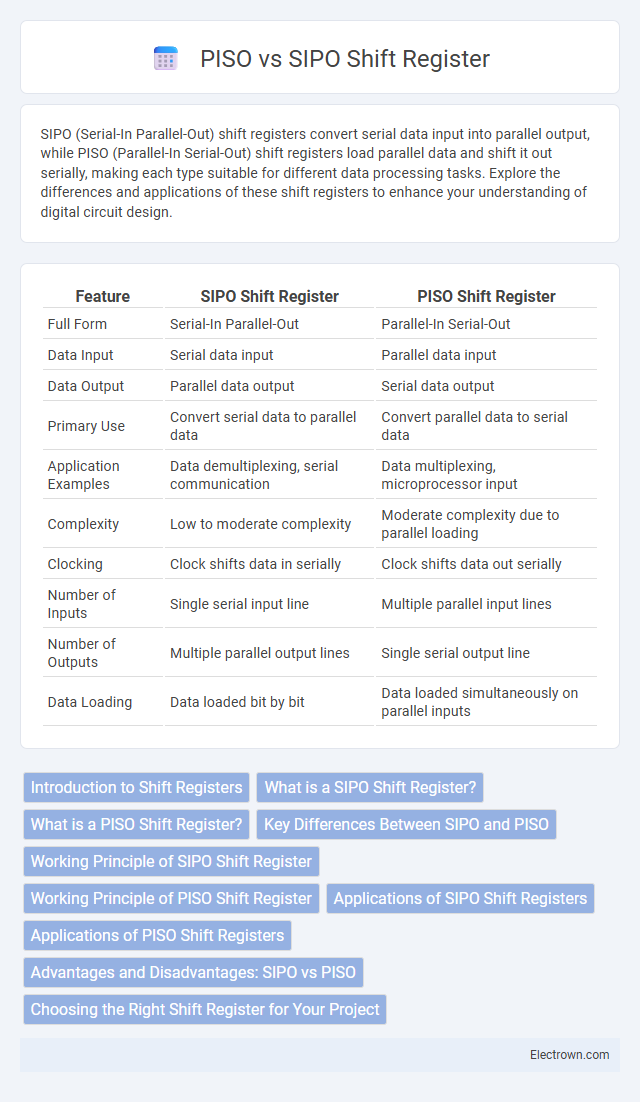
 SIPO (Serial-In Parallel-Out) shift registers convert serial data input into parallel output, while PISO (Parallel-In Serial-Out) shift registers load parallel data and shift it out serially, making each type suitable for different data processing tasks. Explore the differences and applications of these shift registers to enhance your understanding of digital circuit design.
Table of Comparison
| Feature | SIPO Shift Register | PISO Shift Register |
|---|---|---|
| Full Form | Serial-In Parallel-Out | Parallel-In Serial-Out |
| Data Input | Serial data input | Parallel data input |
| Data Output | Parallel data output | Serial data output |
| Primary Use | Convert serial data to parallel data | Convert parallel data to serial data |
| Application Examples | Data demultiplexing, serial communication | Data multiplexing, microprocessor input |
| Complexity | Low to moderate complexity | Moderate complexity due to parallel loading |
| Clocking | Clock shifts data in serially | Clock shifts data out serially |
| Number of Inputs | Single serial input line | Multiple parallel input lines |
| Number of Outputs | Multiple parallel output lines | Single serial output line |
| Data Loading | Data loaded bit by bit | Data loaded simultaneously on parallel inputs |
Introduction to Shift Registers
Shift registers are digital circuits used for data storage or transfer, with SIPO (Serial-In Parallel-Out) and PISO (Parallel-In Serial-Out) being common types. A SIPO shift register converts serial input data into parallel output bits, ideal for data conversion and buffering. Conversely, a PISO shift register takes parallel input and shifts it out serially, enabling efficient data serialization for communication protocols or memory operations.
What is a SIPO Shift Register?
A Serial-In Parallel-Out (SIPO) shift register converts serial data input into parallel data output, allowing simultaneous access to multiple bits. It is commonly used in digital circuits for data storage, data transfer, and parallel data processing applications. The SIPO shift register operates by sequentially shifting bits from the serial input into an internal register and then outputting them in parallel form.
What is a PISO Shift Register?
A Parallel-In Serial-Out (PISO) shift register is a digital circuit that loads multiple bits of data simultaneously through parallel inputs and then outputs the data serially one bit at a time. It is commonly used to convert parallel data into a serial data stream for communication and data processing applications. The PISO shift register enhances data transfer efficiency by enabling simultaneous data loading followed by sequential data transmission.
Key Differences Between SIPO and PISO
SIPO (Serial-In Parallel-Out) shift registers convert serial data input into multiple parallel outputs, enabling simultaneous data retrieval on several output lines. PISO (Parallel-In Serial-Out) shift registers take multiple parallel data inputs and convert them into a serial data output, facilitating sequential data transmission. Your choice between SIPO and PISO depends on whether you need to transform serial data into parallel formats or parallel data into a serial format for efficient communication.
Working Principle of SIPO Shift Register
A SIPO (Serial-In Parallel-Out) shift register operates by receiving serial data input bit by bit on the clock's rising edge and sequentially shifting these bits through a series of flip-flops. Each flip-flop stores a single bit and outputs its state simultaneously, converting the serial input into parallel output data. This functionality enables efficient data conversion and storage in digital circuits, making it ideal for applications where serial data must be processed or transmitted in parallel form.
Working Principle of PISO Shift Register
The PISO (Parallel-In Serial-Out) shift register operates by loading parallel data simultaneously into its flip-flops and then shifting that data out serially one bit at a time with each clock pulse. Your digital system benefits from this mechanism by efficiently converting multiple parallel input signals into a single serial output stream, ideal for simplifying data transmission over serial communication lines. This process contrasts with SIPO (Serial-In Parallel-Out), which accepts serial input and outputs parallel data.
Applications of SIPO Shift Registers
SIPO (Serial-In Parallel-Out) shift registers are widely used in digital communication systems for converting serial data into parallel data, enabling efficient data processing and storage. They play a crucial role in applications such as data buffering, data serialization, and interfacing microcontrollers with parallel devices. Your design can benefit from SIPO shift registers when parallel output conversion is essential for faster and more organized data handling in embedded systems.
Applications of PISO Shift Registers
PISO (Parallel-In Serial-Out) shift registers are essential in applications requiring parallel data to be converted into serial data for efficient transmission or processing. They are commonly used in communication systems for data serialization, microprocessor interfaces for data transfer between parallel and serial devices, and digital signal processing where parallel inputs must be serialized for sequential operations. Your electronic designs benefit from PISO shift registers when integrating parallel sensor data into serial communication protocols like SPI or UART.
Advantages and Disadvantages: SIPO vs PISO
SIPO (Serial-In Parallel-Out) shift registers offer the advantage of converting serial data into parallel data quickly, making them ideal for applications that require data distribution to multiple outputs simultaneously; however, they can be slower for data input as bits are loaded sequentially. PISO (Parallel-In Serial-Out) shift registers allow rapid loading of multiple bits in parallel and then shifting out data serially, which is advantageous for serial communication but can introduce complexity in timing control. Your choice between SIPO and PISO shift registers depends on whether priority lies in efficient parallel data output or fast parallel data input with serial transmission.
Choosing the Right Shift Register for Your Project
Choosing between a SIPO (Serial-In Parallel-Out) and a PISO (Parallel-In Serial-Out) shift register depends on whether your project requires serial data input and parallel output or parallel data input and serial output. SIPO shift registers excel in applications needing serial-to-parallel data conversion, such as interfacing serial sensors with parallel microcontroller pins. PISO shift registers are ideal for parallel-to-serial data conversion, commonly used in serial communication systems to reduce the number of data lines needed for transmission.
SIPO vs PISO shift register Infographic